Your deal flow scales.
Your judgment should too.
More opportunities than time to assess them? NUVC turns the evidence into a brief: the case, the gaps and the questions worth asking. AI-native investment intelligence for fund managers. You decide what deserves a meeting.
Start with your fund’s priorities and the decisions taking your time.

From evidence to a decision
Move from reading to a reasoned decision.
The result is a clearer basis for where to spend your attention, what to ask in a meeting and whether to take an opportunity further.
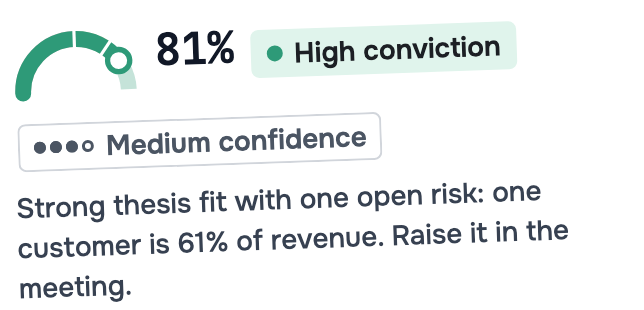
Nu conviction brings opportunity quality and fit with your mandate together. Confidence stays separate: how much evidence supports the assessment.
Nu conviction, with uncertainty in view.
Evidence
Know what needs checking.
NUVC structures the evidence, challenges the case and makes uncertainty visible. Use the brief to focus diligence on what could change the decision.
Ask nextWhat evidence would resolve the open risk?
Mandate
Keep your mandate in view.
An opportunity can look strong and still be wrong for your fund. Review the assessment against your mandate to decide where your attention belongs.
Ask nextDoes this belong in our fund?
Decision
Keep the why behind your decisions.
NUVC keeps your saved deal decisions, reasons and private notes together. Revisit what you decided and why when an opportunity comes back into view.
Ask nextWhy did we take this path?
Portfolio context · upcoming
See what the next deal adds to your portfolio.
Understand what an opportunity adds, where it deepens existing exposure, and which gaps need checking. This upcoming portfolio perspective connects coverage with the questions behind your next investment decision. Explore the illustrative preview below.
Portfolio perspective
Upcoming · illustrative previewWhat changes with this deal?
Fictional candidate · Climate · Seed · New Zealand
Sector coverage
6 holdings
- Software3 of 6
- Climate2 of 6
- Sector unknown1 of 6
Candidate contribution
Seed stage
3 of 6 holdings
Recorded markets
Australia
Each segment represents one holding, not invested capital. One holding has unknown sector, stage and market in both scenarios.
Nu · illustrative interpretation
A familiar sector. A different market.
Climate already accounts for 2 of 6 holdings, and 3 of 6 are seed stage. The candidate would add to both while introducing New Zealand to the recorded markets.
What remains unknown
One holding is missing its market. Confirm it before concluding New Zealand is new coverage.
Your decision
Does a new market justify adding to your existing climate and seed exposure?
Before you begin
Who is this experience for?
Emerging venture fund managers reviewing startup opportunities against a fund mandate. For family office and allocator workflows, explore our Family Office offering.
What do I get from an assessment?
A structured brief with the case for and against, the strength of the available evidence and questions for diligence. Use it to prepare a meeting or decide whether an opportunity deserves further attention. You retain the investment decision.
Is the product preview real customer data?
No. It shows the product using a fictional company and sample data. The funnel, scores and customer concentration are examples, not customer results or a prediction of returns.
How should I read a score and its confidence?
NuScore is shown out of 10. Confidence describes the strength of the available evidence, not the likelihood of investment success. Read both alongside the sources, gaps and questions for diligence.
How is Nu conviction different from NuScore and confidence?
NuScore assesses opportunity quality out of 10. Nu conviction brings that quality together with fit against your mandate and displays the result as a percentage. Confidence separately describes how much evidence supports the assessment. A high conviction reading is not a probability of investment success or a reason to skip diligence.
Does NUVC make the investment decision?
No. NUVC structures the evidence and challenges the case; you decide whether to meet, investigate further, pass or invest. An assessment is not a prediction of investment returns.
Can I revisit my decisions?
Yes. Your deal history brings together saved decisions and the reasons and private notes you added, so you can revisit what you chose and why. The reasons are the ones you provide, and the next decision remains yours.
What happens when evidence is missing?
Treat missing evidence as a question for diligence, not proof that a claim is true or false. Review the confidence and limitations of an assessment before acting on it.
How do I get started?
Tell us what your fund invests in and which decisions are taking the most attention. We can discuss how the assessment supports those decisions and confirm access and plan details with you.
Make room for the decisions that matter.
Bring your fund’s priorities and the questions slowing your reviews. Let’s discuss how evidence-led assessment could support your next investment decision.
Discuss your deal flow